.jpg)

To make a secure online donation, please click the button below

The entire methodology of the Citizenship and Democracy in School project is systematized in a pedagogical notebook, which provides all the necessary information for implementing the initiative in the classroom, with a detailed description of each proposed activity. The project adopts an active and participatory methodology that seeks to encourage students' reflection in the classroom using resources such as: reading texts, analyzing news, reflecting on songs and/or videos. The notebook is available for all those interested.

The elective Rights and Citizenship was created by the Warren Educational Policies Program based on the Citizenship and Democracy in School project as an elective subject, within the scope of its partnership with the Secretary of Education of São Paulo. The Auschwitz Institute has also been working on developing specific materials with the Secretaries of Education of other states, aiming to contribute in the best way to their local strategies.


In addition to the core materials, the Warren Educational Policies Program team also develops complementary materials, always seeking to contribute to the educator's role in the classroom and considering the context in which the Citizenship and Democracy in School project is implemented. In this sense, in 2021, the program launched an activity kit for the returning of in-person classes in Brazilian public education considering the COVID pandemic, and, in 2022, a pedagogical material aimed at contributing to the promotion of safe, plural, and stimulating dialogues on democracy and more specifically on the elections that took place in October in the country. Finally, in February 2024, the Institute launched a material focused on the context of the violent attacks against Brazilian schools, with educational activities to strengthen social cohesion in these spaces.


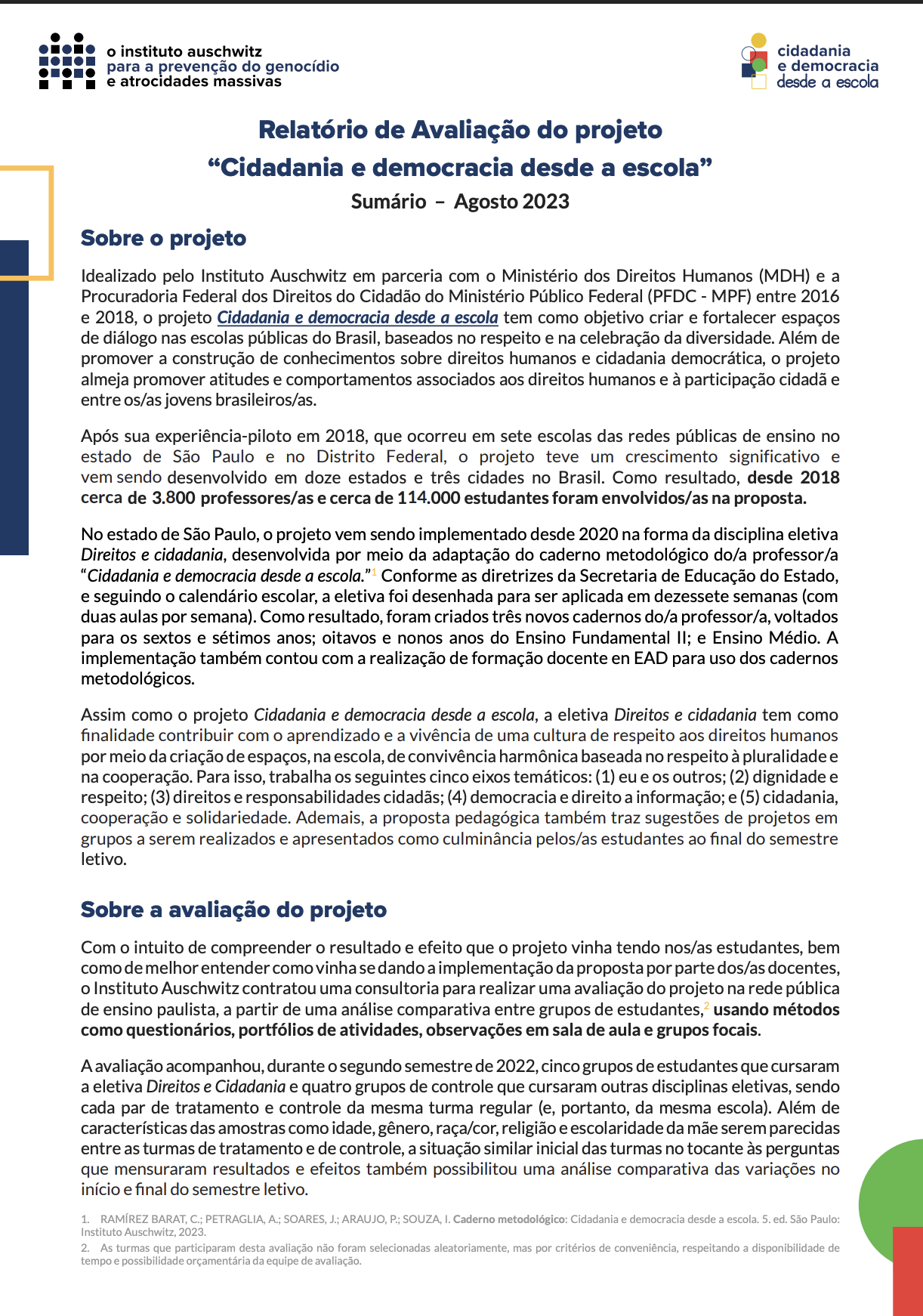
In the second half of 2022, the WEPP team conducted an evaluation in five schools in São Paulo, using treatment and control groups to measure the project’s effects on both teachers and students. The findings were later compiled into a report that presents the evaluation methodology and underscores the initiative’s positive results, including changes in teaching practices and meaningful shifts in students’ understandings, attitudes, and values related to human rights and democracy. A condensed version of these findings is available in the evaluation’s executive summary.
In order to better assist educators in their practical experience with the project, the Warren Educational Policies Program also provides access to a Google Drive with diverse support materials. Click the icon to access the Google Drive.

In 2024, we expanded our work with school leadership through new materials developed as part of our training program for school managers, including school principals and pedagogical coordinators. Among these outputs is the eBook “Citizenship and Democracy in School: How Can Management Act?”, which presents practical cases, participants’ reflections, and theoretical-practical insights on human rights, the prevention of violence, and the promotion of democratic coexistence in schools.
In parallel, the pilot version of the training program implemented with school managers from Paraíba and Rio Grande do Norte was evaluated in partnership with Instituto Unibanco. Released in 2025, the evaluation report highlights promising results, including the strengthening of collective decision-making spaces in schools, new approaches to conflict mediation, and reinforced partnerships with external institutions. The findings informed the consolidation of the final version of the program.